what are some strategies that you have used to keep these portfolios well-organized
Read this article in French, German, Portuguese, Spanish, or Japanese.
New year's day, new you—just same organizational habits? No thank you.
If yous've resolved to exist more organized in the new year's day, yous're not alone—according to the Anatomy of Work Alphabetize 2021, being more organized and finishing work on fourth dimension is one of the top three work resolutions for 2021. Merely despite the fact that millions of people around the world set New Yr's resolutions, previous surveys have shown that less than 8% of people accomplish them. That's because New year'south resolutions are aggressive versions of the people we want to be. When a new year begins, a New year's resolution is a corking way to put your positive intentions out into the world.
But if you resolved to get on acme of your work in 2021, you're in luck—yous're about to be in the 8% of people who accomplish their resolutions. Try these four ways to hit your resolutions and develop your organizational skills in the new yr with Asana.
i. Start your solar day with My Tasks & Inbox
The best way to organize your piece of work is to start every 24-hour interval with a articulate view of what'south on the docket. With My Tasks and Inbox, you tin can see everything that's assigned to you (My Tasks) and any relevant notifications on piece of work you're following (Inbox).
Start your mean solar day in My Tasks. If you lot oasis't already, organize your My Tasks with Sections. Apply Tab + N to create a Section to meliorate organize your work in My Tasks. Organize your sections by task type, priority, task scope, or work block. For more inspiration, check out some example My Tasks system strategies.
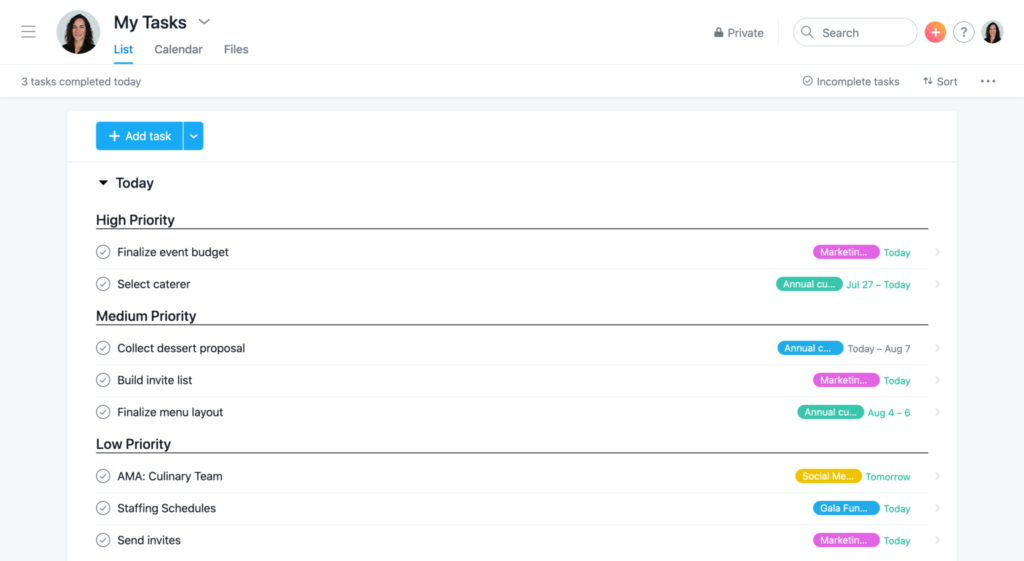
Then, bank check your Inbox for any new notifications. Inbox is your mission command for any relevant notifications. To use your Inbox most effectively, address and archive notifications to reduce ataxia. Once y'all've seen a notification, answer to it or create a follow-up task to capture work, then Archive information technology.
2. View your projection's fundamental information with Project Overview
When you country in a new projection, it can sometimes be difficult to empathise what the projection plan and project objectives are. The four primary projection views are great to manage and execute on work—but you demand a dwelling base for planning and organizing information technology, also.
That's why we've introduced Project Overview—your team's one-stop-shop to gain clarity and share context. With Projection Overview, you tin can organize all of your project's virtually important planning information, like your project brief, stakeholder roles, important documents, fundamental milestones, and more.

To get organized with Projection Overview:
- Fill out Projection Overview for every project y'all manage.
- Navigate to Project Overview whenever someone shares a new project with you. From there, you can go all of the data you lot need near the project's program and purpose.
- Check Project Overview oftentimes. At that place, you tin can detect all of the project's status updates, also every bit a running activity feed of important information.
3. Automate routine work with Rules
I reason we feel so disorganized at work is all of the little tasks that take up brain space and precious fourth dimension. In fact, the average employee spends 60% of their time on work most work—instead of strategic or skilled work. To increase organization and focus on the work that matters, use Rules to reduce some of this manual piece of work. To create a Rule, you'll first ascertain a trigger. When that trigger happens, an activeness will occur.
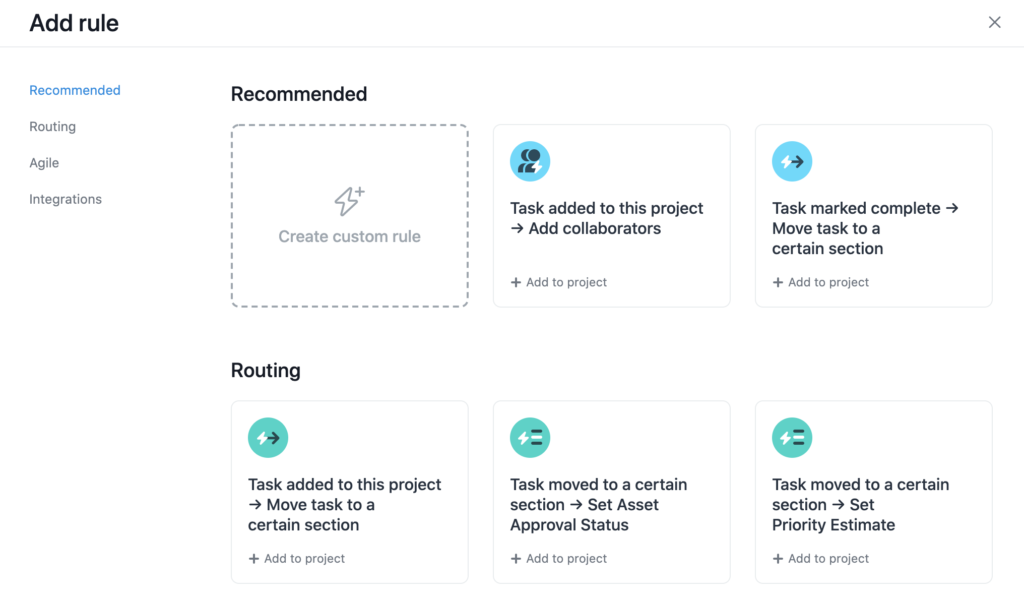
Use Rules to:
- Route work to the appropriate team member. Make sure your project has a custom field related to your squad's work (east.k. creating a "Type of Asking" custom field that maps to the different piece of work each team fellow member does). And so, utilize Rules to automatically assign the chore based on that custom field (e.g. assigning all "Illustration" tasks to Dave, or all "Copywriting" tasks to Blaire).
- Triage Forms job submissions. If you lot've ready up a form for your projection, new form submissions show upwards as tasks. Create a Rule to automatically add together yous and any other important stakeholders as collaborators to the task, and so information technology doesn't become lost in the shuffle. Or, if you've committed to answering all submissions in 48 hours, assign the submission to yourself and set a due appointment for 2 days from the submission date.
- Add together tasks to other projects . For case, if you track all of your Sales deals in a main, section-wide project, you don't want to manually add each new deal in your team project to that project. Instead, create a Rule that automatically adds those tasks to your main department project once a custom field has been updated (e.g. to "Closed deal") or when a task is moved to a certain Department within your project (east.g. "Deals in progress).
- Automatically move tasks through your Boards project. If you work on an engineering team, you probably use Boards View to rail ongoing processes, similar bug tracking or sprint planning. The beauty of Kanban-manner project views is getting at-a-glance insight into each job'south status, based on which cavalcade it's in. Instead of manually moving tasks between columns, create a Rule to move tasks into sure columns based on their custom fields, so yous and your team can focus on your next sprint.
4. Get a bird'due south eye view of your work with Portfolios
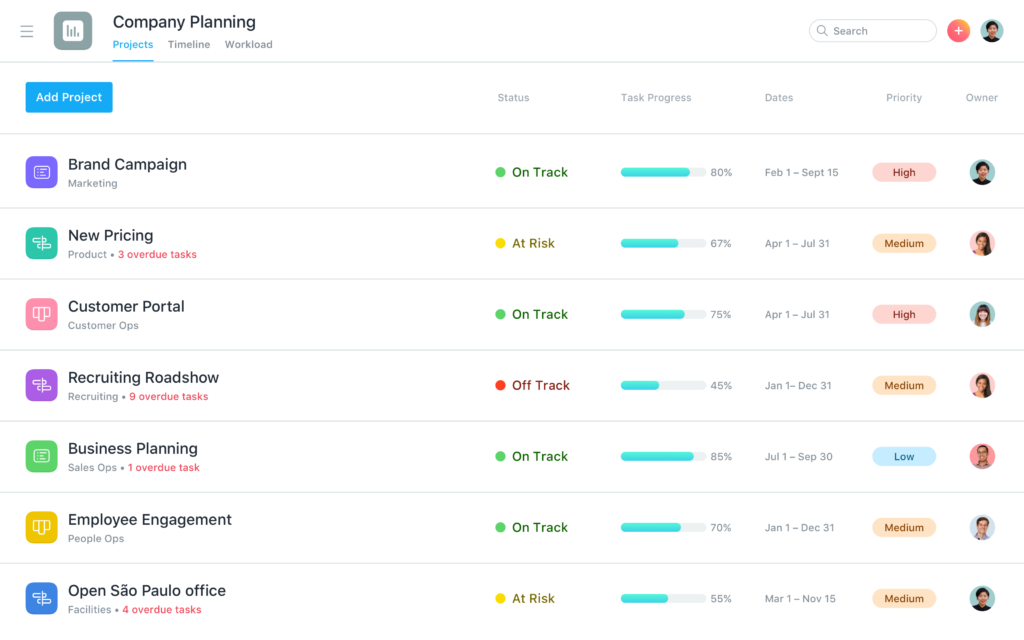
Managing multiple projects can sometimes feel like juggling—and not in a adept way. To reduce the mental ataxia and increase organization at work, group like projects and initiatives with Portfolios.
Portfolios are a great fashion to get organized if you:
- Manage a small team but struggle to get organized insight into your team'due south work. Even if work is captured beyond multiple projects, you lot can use Portfolios to view it all in one place. That mode, instead of having to dig and search for relevant projects, yous have access to your unabridged team's work from one central place.
- Manage cantankerous-functional initiatives and complex processes. Without diligent oversight and an organized system for checking in on work, projects can easily get off rails—but it's hard to remember to check in with each projection. Instead, put all of the projects you oversee in a Portfolio, so you can get a bird's-eye view of every project'southward status from one place. That way, if a projection has an at risk or off rail condition, you can dig deeper into that work and help go the project back on track.
- Want to get started with workload management. Workload management is a great way to support your team and forbid exhaustion. According to the Anatomy of Work Alphabetize 2021, 71% of cognition workers report experiencing exhaustion at least once in 2020. With Portfolios, yous also have access to Workload—so you can see exactly what everyone has on their plate across the multiple projects you manage and easily reassign tasks if anyone is over chapters.
New year, new you
Start the near year with your all-time pes frontward. After 2020, we all need that. And keep in mind these tips aren't but for January, either. With these 4 tips, yous tin establish great working habits for all of 2021, so y'all can continue moving frontwards on your organizational goals well into the new year.
For more than tips and best practices, check out the Asana Academy.
Source: https://blog.asana.com/2021/01/asana-tips-new-year-organization/
0 Response to "what are some strategies that you have used to keep these portfolios well-organized"
Postar um comentário